

DHT and Hair Loss: The Real Reason Your Hairline Is Staging a Retreat
Posted by Stallion on Dec 8th 2025
Look, I'm not going to sugarcoat this—if you've been watching your hairline creep backward like it's trying to escape your face, you're probably frustrated as hell. Maybe you've been Googling at 2 AM, spiraling down rabbit holes about testosterone and wondering if your gym gains are somehow betraying your follicles. And everyone keeps throwing around these three letters: DHT.
But what does that actually mean?
Here's the thing: I've spent years digging into the science of hair loss, talking to dermatologists, reading studies that would put most people to sleep, and testing products that promised miracles but delivered disappointment. And through all of that, one truth became crystal clear—understanding DHT is the key to understanding why your hair is thinning in the first place.
Think of DHT as that friend who was cool in high school but became kind of a problem as an adult. Useful once, now just causing chaos.
In this article, I'm going to break down exactly what DHT is, how it's systematically destroying your hair follicles (dramatic, but accurate), and—most importantly—what you can actually do about it. No BS. No miracle cures. Just the real science, explained like we're having coffee and you asked me to make sense of this mess.
Ready? Let's dive in.
What Exactly Is DHT? (And Why Should You Care?)
Alright, let's start with the basics. DHT stands for dihydrotestosterone. I know—it sounds like something a chemistry teacher would write on a whiteboard to torture you. But stick with me here.
Think of DHT as testosterone's bigger, stronger, more aggressive older brother. You know the type—the one who was great at sports, got all the attention, but also had a bit of a mean streak. Your body naturally converts about 10% of your testosterone into DHT every single day. And here's the kicker: DHT is actually five times more potent than regular testosterone.
Now, before you start cursing DHT entirely, let me be clear—it's not inherently evil. During puberty, DHT was actually your friend. It's what gave you:
- That deeper voice
- Body hair (for better or worse)
- Broader shoulders
- All those "masculine" features we associate with growing up
But as we get older—especially for those of us dealing with stress, lack of sleep, too much takeout, and the general chaos of adult life—DHT starts causing problems. Big ones.
The Hair Follicle Assassination Plot
Here's where things get interesting, and honestly, a little sinister.
DHT loves to bind to receptors in your hair follicles, particularly on the top and front of your scalp. And when it does? It's like putting a slow-acting poison on your follicles. It shrinks them, weakens them, and eventually chokes them out completely.
This process is called follicular miniaturization, which sounds way more technical than it needs to. Basically, your thick, healthy hair follicles start producing thinner, shorter, weaker hairs. Over time, those follicles just... give up. They stop producing hair altogether.
But here's what most people don't understand—and this is crucial—DHT levels aren't the same everywhere on your scalp.
The hair on the back and sides of your head? Those follicles are basically DHT-resistant. They've got natural armor. That's why even guys with severe balding still have hair around the sides. It's like those follicles got the memo about DHT and said, "Nah, we're good."
Meanwhile, the follicles on top are sitting ducks.
The Real Question Nobody's Asking
Now, here's where things get really interesting, and this is something most people completely miss.
Everyone talks about DHT like it's this random villain that just showed up one day to destroy your hair. But that's not how it works. Your body doesn't just randomly decide to flood your scalp with DHT.
The real question isn't "How do I block DHT?"
The real question is: "Why is my body producing so much DHT in the first place?"
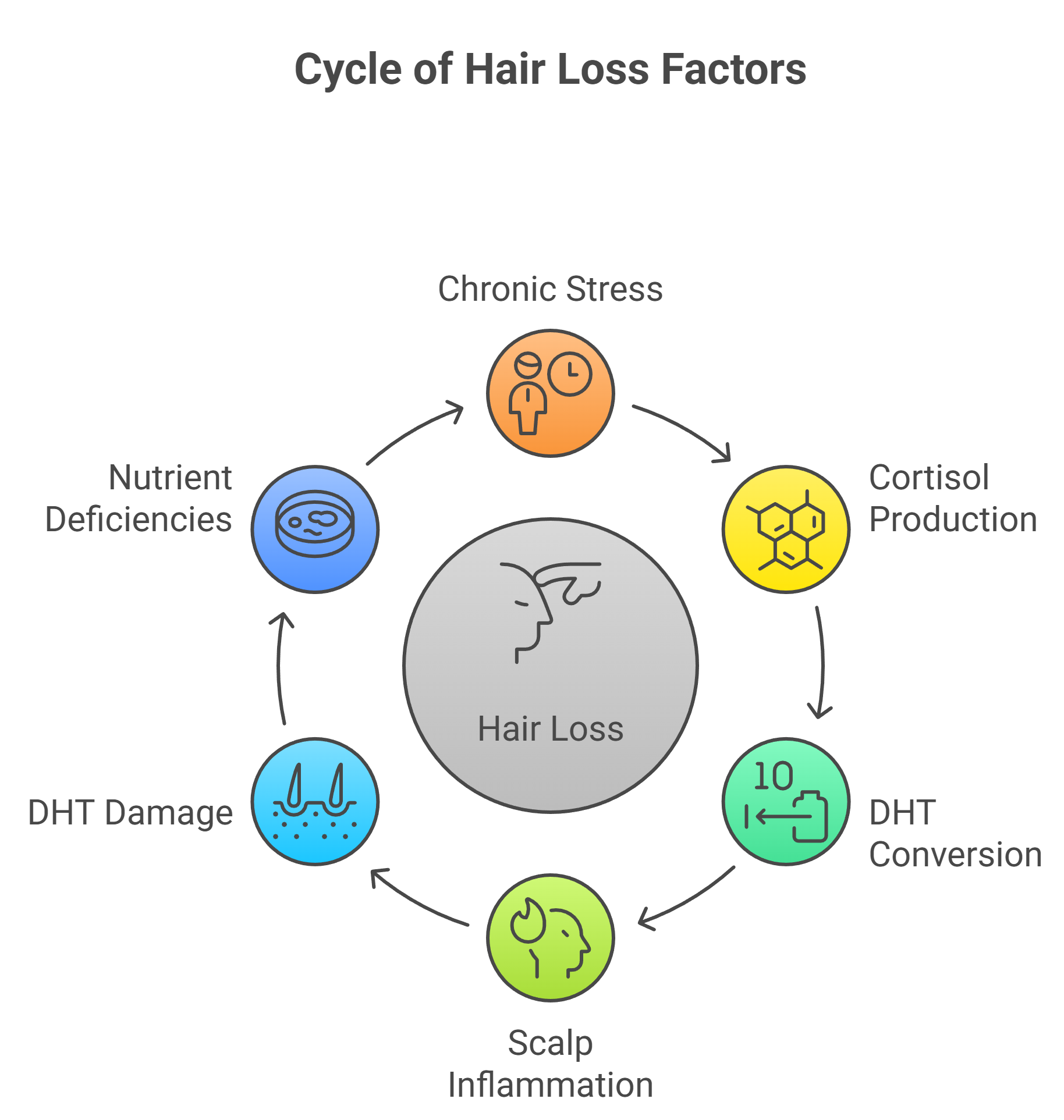
See, there's always a reason. And for most of us—busy, stressed, trying-to-hold-it-together adults—it comes down to three main culprits:
1. Chronic Stress (The Silent Killer)
I'm not talking about the occasional bad day at work. I'm talking about that constant, low-level stress that's become your baseline. Your boss is demanding. Your bills are piling up. You haven't had a full night's sleep in... well, you can't remember.
When you're chronically stressed, your body pumps out cortisol. And cortisol has this nasty habit of increasing the activity of an enzyme called 5-alpha reductase—the very enzyme that converts testosterone into DHT.
It's like stress is literally telling your body, "Hey, let's make more of that hair-killing hormone." Thanks, stress. Really helpful.
2. Inflammation (The Hidden Culprit)
This one's huge, and most people have no idea.
When your scalp is inflamed—whether from poor diet, environmental toxins, or just general poor health—it creates the perfect storm for DHT to do maximum damage. It's like your follicles are already weakened, and then DHT comes in for the finishing blow.
Think of it this way: inflammation is like leaving your front door unlocked. DHT is the burglar who walks right in.
3. Nutrient Deficiencies (You Are What You Eat)
When's the last time you actually paid attention to what you're eating? I mean really paid attention.
Most of us are running on coffee, protein bars, and whatever we can grab between meetings. But your hair follicles need specific nutrients to stay strong and resist DHT damage:
- Biotin (for keratin production)
- Zinc (for cell growth and repair)
- Iron (for oxygen transport to follicles)
- Vitamin D (for follicle cycling)
Without them, it's like trying to fight a battle with broken weapons.
How DHT Actually Destroys Your Hair (The Science Part)
Let me walk you through what's happening on your scalp right now. It's not pretty, but understanding it is the first step to fighting back.
The DHT Attack Sequence
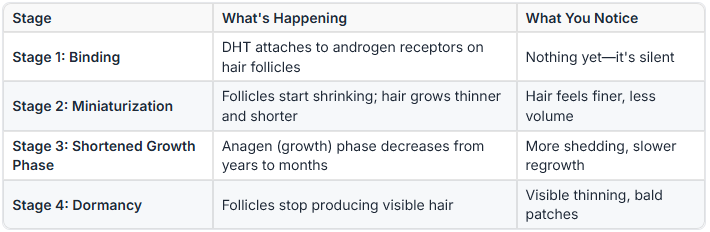
The cruel irony? While DHT is destroying the hair on your head, it's often promoting hair growth everywhere else—your back, your ears, your nose. It's like your body's playing a sick joke.
Why Some Follicles Survive
Remember how I mentioned that the hair on the back and sides of your head is DHT-resistant? That's because of genetics.
Those follicles have fewer androgen receptors, which means DHT can't bind to them as easily. It's why hair transplants work—surgeons take those resistant follicles from the back and move them to the top. The follicles keep their resistance even in their new location.
Pretty clever, right?
What You Can Actually Do About DHT (Real Solutions)
Alright, so now that you understand what's really going on, let's talk solutions.
And I'm not going to sugarcoat this—there's no magic pill that's going to give you a full head of hair overnight. Anyone who tells you otherwise is selling something (and probably lying).
But there are proven approaches that can make a real difference.
Natural DHT Blockers (That Actually Work)
Before you roll your eyes thinking I'm about to sell you some miracle supplement, hear me out. There are actually foods and natural compounds that can help reduce DHT production:
Pumpkin Seed Oil
There's actual research showing it can help block DHT. One study found that men who took 400mg daily for 24 weeks saw a 40% increase in hair count. Not bad for a seed.
Saw Palmetto
This works by inhibiting that 5-alpha reductase enzyme I mentioned earlier. It's basically telling your body, "Hey, maybe don't convert all that testosterone into DHT."
Green Tea (EGCG)
The compound EGCG in green tea has been shown to reduce DHT levels. Plus, it's loaded with antioxidants that help reduce inflammation.
Stinging Nettle
Sounds painful, but it's actually a powerful DHT blocker. It works by binding to the same receptors DHT targets, essentially blocking DHT from getting to your follicles.
But here's the thing—and this is where most people go wrong—you can't just pop a saw palmetto pill and expect miracles. You need to address the root causes we talked about.
The Three-Pronged Attack Strategy
1. Manage Your Stress
I know, easier said than done. But even small changes matter:
- 10 minutes of meditation in the morning
- Actually taking that lunch break instead of eating at your desk
- Saying no to that extra project that's going to keep you up until midnight
- Exercise (which also helps regulate hormones)
2. Reduce Inflammation
This is huge:
- Cut back on processed foods
- Add more omega-3s to your diet (fatty fish, walnuts, flaxseed)
- Consider anti-inflammatory herbs like turmeric
- Drink more water (your scalp is skin, and dehydrated skin is inflamed skin)
3. Give Your Follicles What They Need
Quality matters here. Most supplements you find at the grocery store are basically expensive urine. Look for:
- Biotin (5,000-10,000 mcg daily)
- Zinc (15-30 mg daily)
- Iron (if you're deficient—get tested first)
- Vitamin D (2,000-4,000 IU daily)
Topical DHT Blockers: The Middle Ground
This is where things get interesting. Topical treatments can block DHT locally without the systemic effects of oral medications.
Products containing ingredients like:
- Saw palmetto extract
- Pumpkin seed oil
- Rosemary oil (shown to be as effective as 2% minoxidil in one study)
- Caffeine (yes, really—it counteracts DHT at the follicle level)
The advantage? You're targeting the problem area directly without affecting DHT levels throughout your entire body. The disadvantage? Results can be slower and less dramatic than prescription options.
Now, here's where I have to mention something that's been a game-changer for a lot of guys I've talked to. We developed the Mane Growth Elixir specifically with these principles in mind. It's got over 40 natural botanicals, including many of the DHT blockers I just mentioned—saw palmetto, pumpkin seed oil, rosemary—plus circulation boosters and follicle nourishers.
But here's the thing, and I want to be completely transparent with you: topical treatments work best when you're also addressing the internal factors. It's not magic. It's science. You're attacking the problem from multiple angles—blocking DHT topically while also managing stress, reducing inflammation, and supporting your follicles with proper nutrition.
That's the real secret. Not one miracle product, but a comprehensive approach.
If you're interested in checking out the Mane Growth Elixir, you can learn more here. But whether you use our product or another quality topical treatment, the key is consistency and pairing it with the lifestyle changes we've talked about.
Medical Treatments: The Heavy Hitters
If natural approaches aren't cutting it, there are medical treatments that specifically target DHT. Let's talk about the big two:
Finasteride (Propecia)
This is the prescription DHT blocker. It works by inhibiting 5-alpha reductase, which means less testosterone gets converted to DHT.
The Good:
- Clinically proven to work (stops hair loss in 90% of men)
- Can actually regrow hair in about 65% of users
- One pill a day—easy
The Not-So-Good:
- Potential side effects (sexual dysfunction in 2-4% of users)
- Requires a prescription
- You have to take it forever—stop, and the hair loss resumes
Minoxidil (Rogaine)
This doesn't actually block DHT, but it's worth mentioning because it works differently—by increasing blood flow to follicles and extending the growth phase.
The Good:
- Available over-the-counter
- Works for about 60% of users
- Can be combined with finasteride for better results
The Not-So-Good:
- You have to apply it twice daily (forever)
- Can cause scalp irritation
- Initial shedding phase (which freaks people out)
Topical DHT Blockers: The Middle Ground
This is where things get interesting. Topical treatments can block DHT locally without the systemic effects of oral medications.
Products containing ingredients like:
- Saw palmetto extract
- Pumpkin seed oil
- Rosemary oil (shown to be as effective as 2% minoxidil in one study)
- Caffeine (yes, really—it counteracts DHT at the follicle level)
The advantage? You're targeting the problem area directly without affecting DHT levels throughout your entire body. The disadvantage? Results can be slower and less dramatic than prescription options.
Setting Realistic Expectations (The Truth Bomb)
Let me be real with you for a minute.
If you're expecting to go from a receding hairline to a full mane in 30 days, you're going to be disappointed. Hair growth is slow. The average hair grows about half an inch per month. And if your follicles have been damaged by DHT for years, it takes time to reverse that damage.
Here's a realistic timeline:
Month 1-2:
Reduced shedding. You'll notice less hair in the shower drain. This is actually a big deal—it means you're stopping the bleeding.
Month 3-4:
Hair feels thicker, stronger. Existing hairs are healthier because they're not being attacked by DHT.
Month 6-9:
Visible regrowth. This is when you start seeing real results. New hairs filling in thin areas.
Month 12+:
Maximum results. This is as good as it's going to get with your current approach.
But here's what I can promise you: if you stick with it, if you're consistent, if you address both the internal and external factors, you will see improvement.
Maybe not the full head of hair you had at 18, but definitely better than where you are now. And honestly? Sometimes that's all it takes to get your confidence back.
Is DHT Causing Your Hair Loss?
Take this quick 60-second assessment to find out
1. Where is your hair thinning most noticeably?
2. Do you have a family history of male pattern baldness?
3. When did you first notice hair thinning?
4. How would you describe your hair texture changes?
5. Have you noticed increased body or facial hair?
Frequently Asked Questions About DHT and Hair Loss
Does high DHT mean high testosterone?
Not necessarily. Here's the thing: DHT is derived from testosterone, but having high testosterone doesn't automatically mean you'll have high DHT or hair loss.
It's more about:
- How much 5-alpha reductase enzyme you have (genetics)
- How sensitive your follicles are to DHT (also genetics)
- Your overall hormonal balance
I've known guys with sky-high testosterone and perfect hair, and guys with average testosterone who are balding. It's not a direct correlation.
Can you reverse DHT hair loss?
The honest answer? It depends on how far gone your follicles are.
If the follicles are miniaturized but still alive, yes—you can potentially reverse the damage with DHT blockers and proper treatment. But if the follicles are completely dead (which happens after years of DHT damage), no amount of treatment will bring them back.
That's why early intervention is crucial. The sooner you address DHT-related hair loss, the better your chances of keeping and regrowing hair.
What are the signs of high DHT?
Beyond hair loss, high DHT can cause:
- Acne (especially on the back and shoulders)
- Oily skin
- Increased body hair
- Prostate issues (in older men)
- Mood changes
But here's the catch: you can have "normal" DHT levels and still experience hair loss if your follicles are genetically sensitive to it. It's not always about the amount—it's about the response.
Does blocking DHT affect muscle growth?
This is a big concern for guys who lift. The short answer: not really.
Testosterone is the primary hormone for muscle growth, not DHT. Blocking DHT (with finasteride, for example) doesn't significantly impact your testosterone levels or your ability to build muscle.
Some guys report feeling slightly less aggressive or motivated, but studies haven't shown any significant impact on muscle mass or strength gains.
Are there any foods that increase DHT?
Yes, and you might want to moderate these if you're fighting hair loss:
- Red meat (high in saturated fat, which can increase DHT)
- Dairy products (especially full-fat)
- Refined carbs and sugar (spike insulin, which can increase DHT)
- Alcohol (disrupts hormone balance)
On the flip side, foods that may help lower DHT:
- Green tea
- Pumpkin seeds
- Mushrooms (especially white button mushrooms)
- Tomatoes (rich in lycopene)
- Soy products (in moderation)
The Lifestyle Factors Nobody Talks About
Here's something that doesn't get enough attention: your lifestyle choices are either feeding DHT or fighting it.
Sleep (The Underrated Hero)
Poor sleep increases cortisol, which increases 5-alpha reductase, which increases DHT. See the pattern?
Aim for 7-9 hours of quality sleep. Your hair (and your sanity) will thank you.
Exercise (The Double-Edged Sword)
Regular exercise is great—it reduces stress, improves circulation, and helps regulate hormones. But here's the catch: excessive high-intensity exercise can actually increase DHT.
If you're doing intense workouts 6-7 days a week, you might be inadvertently making your hair loss worse. Balance is key.
Smoking and Alcohol (The Obvious Villains)
Both increase oxidative stress and inflammation, creating the perfect environment for DHT to wreak havoc. If you're serious about keeping your hair, these need to go.

My Personal Take (After Years of Research)
Look, I've been down this road. I've tried the supplements, the shampoos, the oils, the prayers to the hair gods. And here's what I've learned:
DHT doesn't have to be the end of your hair story.
Yes, it's a factor—a big one. But it's not some unstoppable force. When you understand what's really driving DHT production in your body, when you address those root causes, when you give your follicles the support they need—that's when real change happens.
Is it easy? No.
Is it quick? Definitely not.
Is it worth it? Absolutely.
Because at the end of the day, this isn't just about vanity (though there's nothing wrong with wanting to look good). It's about taking control. It's about not letting genetics or hormones or stress dictate how you feel about yourself.
The Bottom Line
DHT is the primary culprit behind male pattern baldness, but it's not working alone. It's part of a complex system involving genetics, hormones, lifestyle, and environmental factors.
The good news? You have more control than you think.
Whether you choose natural DHT blockers, prescription medications, topical treatments, or a combination of all three, the key is consistency and patience. Hair loss didn't happen overnight, and reversing it won't either.
Start with the basics:
- Manage your stress
- Clean up your diet
- Get quality sleep
- Consider natural DHT blockers
- If needed, talk to a dermatologist about medical options
And remember: progress, not perfection. Even slowing down hair loss is a win. Even maintaining what you have is a victory.
Ready to Take the Next Step?
Look, I get it. You've read the science, you understand what DHT is doing to your follicles, and now you're probably wondering, "Okay, but where do I actually start?"
That's exactly why we created the Mane Growth Elixir. After years of research into what actually works—not what sounds good in marketing copy, but what the science supports—we packed over 40 natural botanicals into one formula. Saw palmetto, pumpkin seed oil, rosemary, stinging nettle, and circulation boosters that help your follicles fight back against DHT.
But here's what I want you to know: this isn't a magic potion. It works best when you're also doing the work—managing stress, eating right, getting sleep. It's one powerful tool in your arsenal, not the entire army.
We back it with a 90-day guarantee because honestly, that's how confident we are in what we've created. If it doesn't work for you, get your money back. No questions asked. No hoops to jump through.
Check out the Mane Growth Elixir here and see if it's the right fit for your hair growth journey.
Your hair doesn't define you, but if keeping it makes you feel more confident, more like yourself? Then it's worth the effort.
Now stop reading and start doing. Your future hairline will thank you.